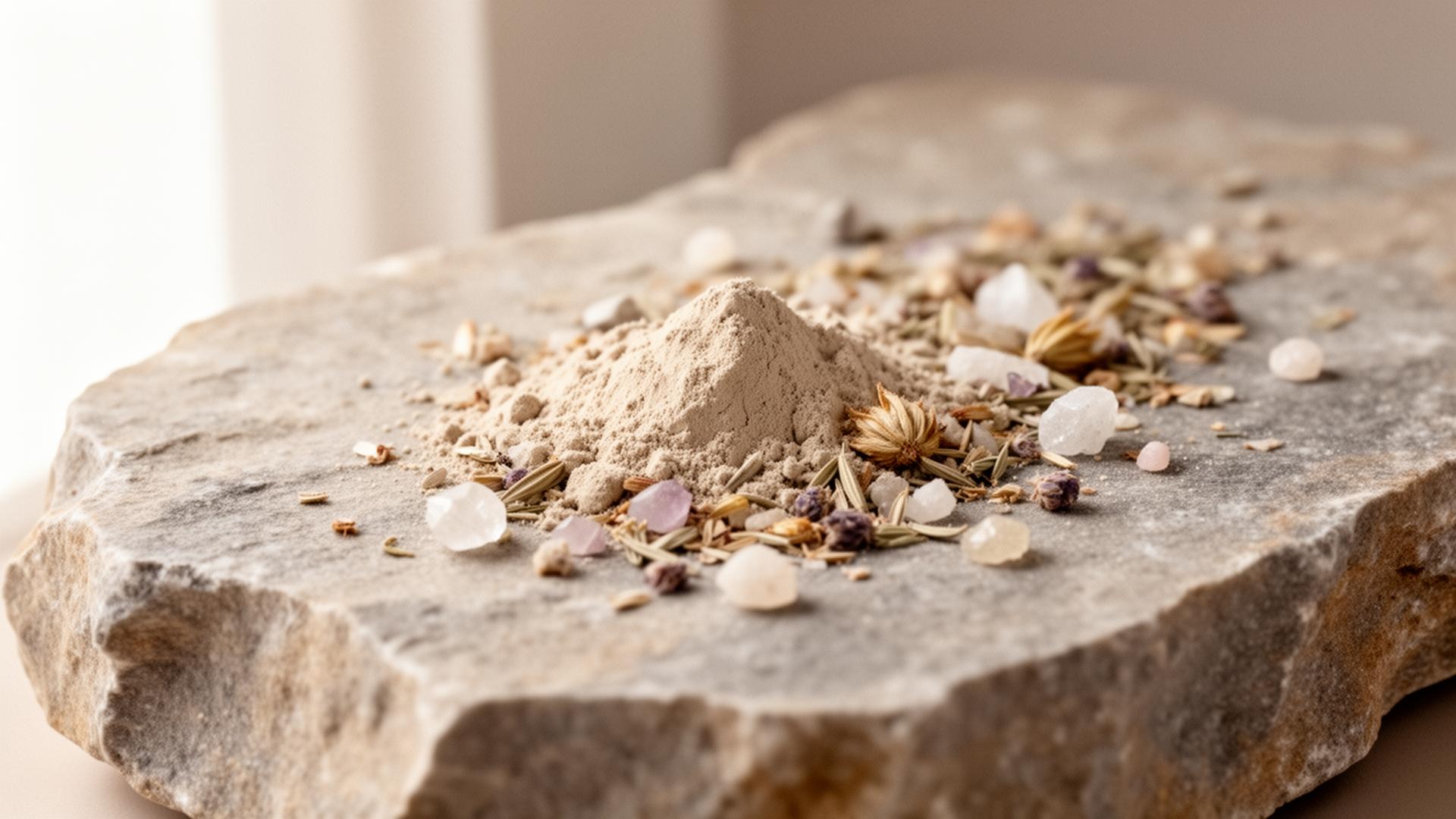
A formula at full concentration, activated only when you choose to begin.
Engineering
Eleven principles
Powder is not a marketing format. It is a structural choice that changes everything downstream — what goes into the bottle, what stays out, how the wash performs, and how long the formula lives. What follows is the engineering logic of the studio's powder system, articulated as eleven principles.
Water content
0% vs. 60–80%
Activation time
15–60s at 40°C
Washes per 100g
~130 vs. ~50 liquid
Synthetic preservatives
None. Held by physics.
I — The Postulate
Why powder. Why now. Why at all.
01
Why no water
The central ingredient that does no work.
Liquid shampoo60–80% water
KESH formula0% water
Carbon footprint~80% lower in transport
Conventional shampoo is mostly water. Water you pay to ship, store, and preserve.
Liquid shampoo's largest ingredient is the one that does no functional work. Water dilutes the actives, demands preservatives to keep it from spoiling, and inflates the carbon and packaging weight of the product by an order of magnitude.
The studio removes water entirely from the formula — and only adds it back at the moment of use, when it is structurally needed. What remains in the bottle is the formula at full concentration.
WaterlessLogisticsCarbon
02
Concentrated formulations
Every gram is active. Nothing in the bottle is inert.
Dose per wash~1 g
100 g yields~130 washes
Equivalent2.5–3 standard liquid bottles
100 grams of powder. Roughly three liquid shampoo bottles. Identical performance.
The studio's concentration is not a marketing claim. It is structural: there is no water to dilute the formula, no thickener to bulk it, no preservative to occupy mass. What enters the vessel is the formula itself — the working ingredients, in proportion.
Per wash, the powder works out to under one gram of active material. The formula is engineered to disperse, foam, and rinse cleanly at that exact dose.
DensityPer-gram valueRefill economy
II — The Particle
Microns matter. The formula is an aggregate of solids.
03
Particle structure
Particle size is not a detail. It is the formula.
Saponin carriersD50 · 180–250 µm
Mucilage botanicalsD50 · 250–425 µm
Clay phaseD50 · 75–150 µm
ValidationLaser diffraction + sieve
Each botanical has its own optimal particle size. The wash is the sum of those choices.
The saponin carriers — reetha and shikakai — are milled to 180–250 microns to hydrate fast and foam cleanly. The mucilage botanicals — fenugreek, marshmallow, hibiscus — are held coarser to prevent the gel-clumping that ruins so many natural powder systems. The clays are sieved to a fineness that registers on the scalp as silk, not grit.
The studio specifies D10/D50/D90 targets per ingredient class and validates them through laser diffraction and sieve analysis on every batch. Particle size is the difference between a formula that activates and one that turns to paste.
PSDQCMaterial science
04
Dispersibility
From dry mineral to functional surfactant in under a minute.
Target activation15–60s at 40°C
ProcessFluid-bed agglomeration
ResultPorous, instant-wettable surfaces
Dispersibility is the make-or-break property of any powder system.
Too slow and the user gives up before lather forms. Too fast and the powder over-foams and rinses through before it has done its work. The studio engineers the dispersion window deliberately — activation between fifteen seconds and one minute at warm-water temperature.
The mechanism is fluid-bed agglomeration: particles are pre-engineered with porous, instant-wettable surfaces so that water finds them, infiltrates them, and breaks them down at a controlled rate. Nothing about the speed is accidental.
Hydration kineticsAgglomerationUser experience
05
Preservation without dilution
No water means no microbiology. No microbiology means no preservatives.
Loss on drying< 5% at 105°C
Water activity (aw)< 0.6
Shelf life24+ months
Synthetic preservativesNone
The formula is preserved by its own physics.
Liquid cosmetics require parabens, phenoxyethanol, or similar preservatives to suppress microbial growth in their water phase. Powder systems, held below 0.6 water activity, are inhospitable to bacteria, yeast, and mold by definition.
Loss on drying held under 5%. Anti-caking maintained through silica or starch carriers. The shelf life extends past twenty-four months without a single synthetic preservative — because there is nothing for a microbe to eat.
Preservative-freeWater activityStability
III — The Activation
Dormant until you choose to begin.
06
Activation through water
Three reactions in sequence. The wash begins in the palm.
Stage oneSaponins release
Stage twoMucilage swells
Stage threeAcidifiers shift pH
The formula is a closed system at rest.
When water meets the powder, three reactions occur in sequence. The saponin pods — reetha, shikakai, soapwort — release their natural surfactants. The mucilage botanicals — hibiscus, marshmallow, aloe — swell into slip. The acidifying compounds in amla and hibiscus shift the resulting paste into the cuticle's preferred pH band.
The user is not blending a product. They are initiating one.
SequenceReaction kineticsIn-palm chemistry
07
Sensory transformation
Powder, paste, foam, rinse. Four states in three minutes.
State oneDry powder · 0s
State twoHydrated paste · 30s
State threeActive foam · 90s
State fourClean rinse · 180s
The wash is a sequence of material changes the user can feel under their fingers.
The powder hydrates into a soft paste. The paste foams under massage. The foam rinses clean without residue. The scalp registers as cool, neutral, and balanced. Each transition is a deliberate moment in the formula's life cycle.
This is the difference between using a product and performing a ritual. The transformation itself is the experience.
Sensory designPhase changeRitual
IV — The Wash
Foam tuned for cleansing, not for theatre.
08
Foam architecture
Medium-volume. Fine-bubble. Fast-collapsing on rinse.
Saponin load15–25% by mass
Bubble structureFine, creamy
Collapse on rinseFast, residue-free
Sulfate foam is loud and persistent. Saponin foam is sufficient and quiet.
Sulfate-based foams are voluminous because the surfactant binds tightly to water — performance optics, not performance. Saponin foam from reetha and shikakai is lower in volume, finer in bubble structure, and collapses cleanly during rinse. Which is precisely what the wash actually requires.
The studio tunes the foam profile through saponin ratio (15–25% by mass) and particle fineness (sub-180 µm activates faster). The user perceives a clean wash — without the synthetic squeak of a conventional shampoo.
Saponin scienceFoam indexRinse clarity
09
Cleansing balance
Sebum lifted, lipid barrier intact.
AdsorptionReetha + multani mitti
AcidificationAmla + hibiscus
ReconditioningAloe + licorice
A cleanse is a controlled extraction. The studio engineers for the centre of the range.
Lift too little and the scalp stays heavy. Lift too much and the lipid barrier collapses, triggering rebound oil within twenty-four hours. The studio's saponin-clay-mucilage architecture is calibrated for the narrow band where neither failure mode occurs.
Reetha and multani mitti adsorb sebum and product residue. Shikakai operates at a low pH that protects the cuticle. Aloe, hibiscus, and licorice rebuild the conditioning layer in the same wash. The scalp emerges clean, not stripped.
Sebum balanceBarrier intactSingle-step wash
10
Scalp interaction
A barrier, a microbiome, and a pH system. The wash respects all three.
Native scalp pH4.5–5.5
KESH wash pHWithin band
Microbial impactModulated, not sterilised
Most shampoos disrupt the scalp ecosystem. The studio's formulas leave it intact.
The healthy scalp sits at pH 4.5–5.5 — slightly acidic, acid-mantle protected, and populated by a microbial community essential to its function. Conventional shampoos commonly fail on all three counts: they alkalise, they strip lipids, they over-sterilise.
KESH formulas are pH-tuned by amla and hibiscus, lipid-buffered by aloe and licorice, and microbiome-respectful by using neem at sub-disruptive percentages. The wash works with the scalp's biology rather than around it.
pH disciplineMicrobiomeBarrier function
V — The Ritual
Each step is engineered. None is incidental.
11
Ritual mechanics
Measure. Activate. Massage. Rinse. The protocol is the product.
Dose~1g, sculpted scoop
Activation30s in palm with warm water
Massage60s at the scalp
Rinse90s, warm to cool
The ritual is not aesthetic packaging around a product. It is the operating procedure for the formula.
Each step is calibrated. The dose — one gram, measured by the sculpted scoop — controls foam volume. The activation time ensures full dispersion before scalp contact. The massage distributes the surfactant evenly. The cool finish closes the cuticle and locks the wash's pH correction in place.
The instructions are not rules. They are the mechanism that makes the formula work.
ProtocolDose precisionCuticle close
The position
This is where KESH becomes technologically differentiated. Not just aesthetically differentiated.